
AI visibility audits for search and recommendations.
Being found is only the start. Is your business among the first recommendations customers see? Logue Media identifies gaps in your website’s clarity, credibility and readiness for SEO, local search and AI recommendations.
Can AI search find your business—and recommend it?
Logue Media reviews whether your website clearly explains who you help, what you deliver and why customers should consider you. AISRO means AI Search & Recommendation Optimisation. The goal is prominent, relevant recommendations supported by mentions, citations and source cards—not simply being discoverable. You receive evidence-backed findings and priorities—not a promise of rankings.
Before you spend on another fix
Is the problem discovery, confidence or the next step?
A website can be accessible yet leave buyers unsure what you offer. It can explain the service but provide little proof. Or it can attract interest and lose it at the enquiry form. The audit separates those problems.
01
Can customers find the right page?
Unclear page roles, disconnected links or visible indexing controls can obstruct discovery. The report identifies what the reviewed evidence supports.
02
Can they decide whether you fit?
Missing scope, service coverage, project evidence or buying answers leaves people comparing assumptions instead of your offer.
03
Can they take the next step?
A vague enquiry route, missing pricing guidance or unexplained process can leave an interested buyer with nowhere useful to go.
Products & Services
One starting point. A clear next step.
Start with diagnosis if the cause is unclear. Choose repair or creation when the work is already defined. Select a product to compare its purpose and deliverables.
01
Find what is weak, unclear or missing.
Client Facing Audit Report (CFAR)
Start here when you need a supported picture of the selected website pages. The report records findings, their evidence and readiness scores across the audited areas.
You receive: A CFAR, the Business Owner Strategic Report and the advisory support included in the selected package.
02
Turn findings into a sequence of work.
Client Website Action Plan (CAP)
Choose this when you need to decide which changes come first and who should act. CAP builds on confirmed audit findings rather than creating a disconnected checklist.
You receive: The selected CFAR and CAP package, with its owner-facing reports and included advisory support.
03
Improve a page that already exists.
Client Webpage Repair Tool (CWRT / CWRT+)
Choose repair when a page has a job to do but its copy, structure, proof or enquiry route is weak. The standard report defines changes; the plus version adds design, review and implementation deliverables.
You receive: The agreed page-repair output and guidance. Confirm your website environment and who will install and release it.
04
Fill a missing page or buyer answer.
Client Webpage Creation Tool (CWCT / CWCT+)
Choose creation when your existing website lacks a necessary service, evidence or supporting page. The work covers its purpose, research, structure and copy. The plus version adds visual design and review.
You receive: The agreed new-page output and guidance for your site. Larger requirements move to a website project scope.
What we review
SEO, local search and AI visibility need different questions.
Compare the scope of each review. Findings stay tied to the selected pages and the evidence available.

Can search engines and people follow the website?
A buyer should be able to move from a search result to the right service, inspect the evidence and understand the next step. We review whether the selected pages make that journey clear—and whether their structure gives search engines a consistent explanation of the business.
- Page purpose: Do titles, headings and copy answer the same buyer need, or do several pages compete with near-identical content?
- Connected information: Can visitors reach supporting services, project evidence and contact details through useful internal links? Are important pages isolated or buried?
- Technical signals: Do visible indexing instructions, canonical references and structured data support the intended page purpose, or point elsewhere?
What you gain: Findings tied to specific pages, with the issue and its practical consequence explained. For example, a service page may attract interest but leave buyers without proof or a clear enquiry route. Search Console access and a wider crawl are separately scoped where needed.

Does the website explain where and how you serve customers?
Local customers need to know more than the town name. Can they visit you, will you travel to them, or is the service delivered remotely? We check whether the selected pages answer those questions consistently and give customers a reason to choose you for work in their area.
- Business details: Are your name, contact information, genuine premises and appointment arrangements clear and consistent across the reviewed pages?
- Service coverage: Which services are available in each area? Are travel limits, on-site work and remote delivery explained without implying an office you do not have?
- Local substance: Do location pages contain relevant projects, customer needs and delivery details—or repeat the same copy with a different town name?
What you gain: Specific gaps and conflicting claims to correct, plus opportunities to make each location page useful to its intended customers. Website findings do not establish private Business Profile performance or guarantee a Maps placement.

Are you among the first recommendations customers see?
A mention names your business. A citation links to a source. A tile or card gives that source a visual presence, sometimes with an image. What matters is whether the answer recommends you for the buyer’s needs, where you appear and whether customers see you before selecting “show more”.
Our website review checks the service detail, suitability and credible evidence that support those outcomes. Establishing your actual recommendation position requires a separately agreed review of live AI answers; website readiness alone does not prove a top-three placement.
Why position matters: First Page Sage’s September 2026 study reports that the first three citations received 77.9% of AI-answer clicks in its dataset. This is a reported share of clicks, not a 77.9% click-through rate or a guaranteed result. Read the citation-position study and methodology.
What you gain: Answer and evidence gaps to address. This is readiness analysis, not proof that ChatGPT, Gemini or Google will cite the business.
From the plan to the work
Start with evidence. Then decide what deserves the budget.
A useful audit helps you choose between repairing a page, adding proof, creating missing content or planning a wider website change.
How we work
Which pages need attention—and who will act on the findings?
Start with the services you need to sell. Agree what we review, inspect the evidence and choose how the findings will be used.

Agree the question before reviewing the website.
Bring your website address, priority services, target customers and the questions your sales team keeps answering. Tell us whether the concern is poor visibility, unclear recommendations or visits that do not become enquiries. Together we select the pages and confirm whether you need diagnosis through CFAR, an action plan through CAP, or a defined repair or creation scope.
Output: An agreed page list, selected deliverables and required inputs. Account access or live AI-answer testing is included only when expressly scoped.

Separate what is visible from what needs access.
Logue Media reviews the selected pages for search structure, buyer answers and evidence supporting the offer. We distinguish an observed defect—such as conflicting service-area claims—from a question that needs account data or further investigation. Findings should identify the affected page and explain why the issue matters.
Output: The findings and owner-facing reports included in your selected package, manually checked by Logue Media. Observations, limitations and unresolved questions remain visible.

Give each recommendation an owner.
Review the findings with your team and decide what to address first. Where CAP is included, use the action plan to organise the work. Your developer can implement changes, or Logue Media can quote separately. Agree who supplies missing proof, who edits the page, who approves it and what must be checked before release.
Output: A clear handover for the selected package. Purchasing an audit does not automatically authorise website changes or include implementation.
Audit delivery
What happens after you choose an audit?
Work with Logue Media in Umina Beach. Suitable audits and advisory are delivered remotely across Australia, with in-person discussion available on the Central Coast.



Inspect the output
See what you receive before choosing the scope.
These published examples explain the deliverables. They are not client search results or ranking guarantees. Hover, focus or tap a card for details.

Client Facing Audit Report
Published product example
Client Facing Audit Report
See how findings, evidence and readiness are presented. Confirm the current report version and package scope before ordering.
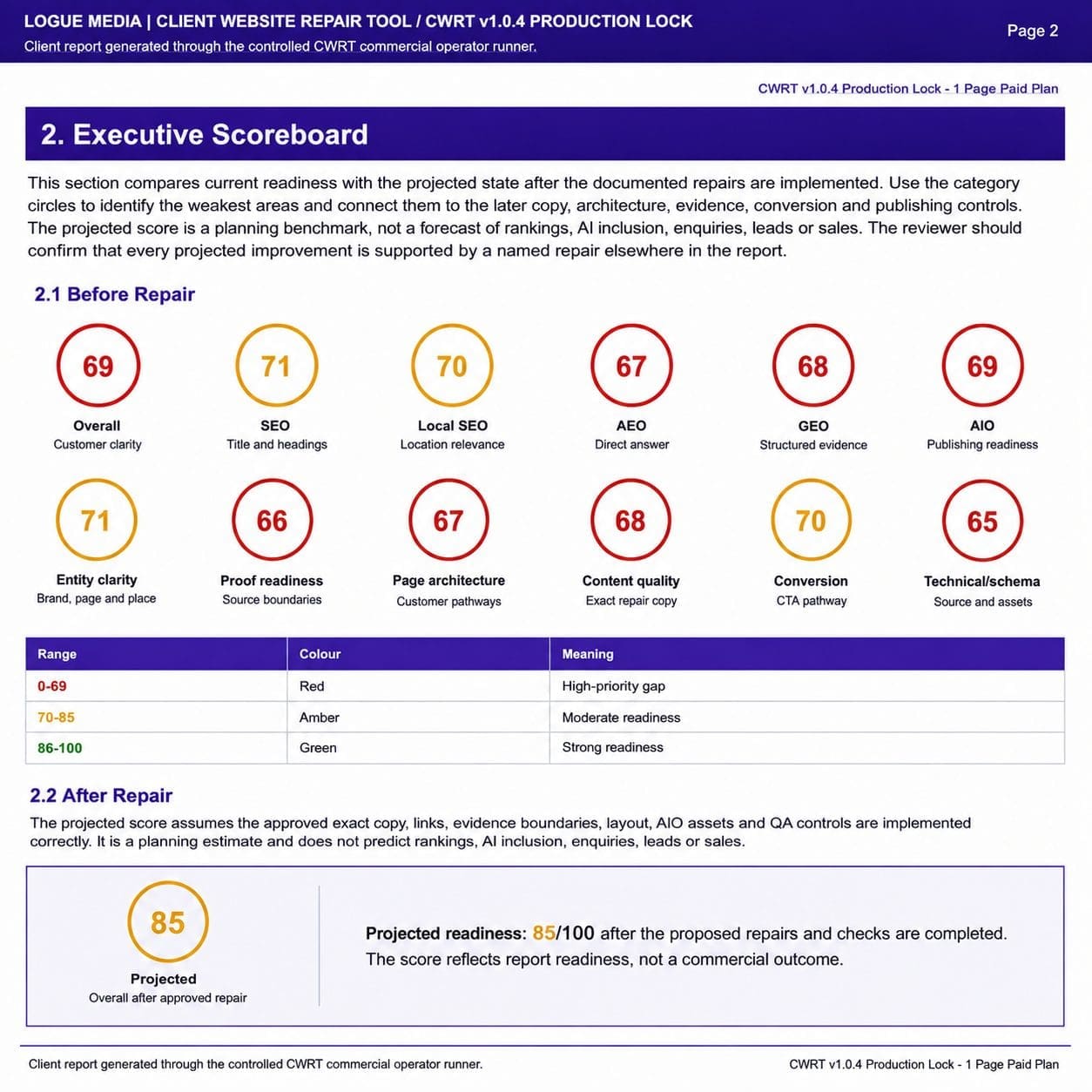
Webpage repair
Published product example
Webpage repair
Review the repair approach for an existing page. The standard report defines changes; the plus service adds design, review and implementation deliverables within the agreed scope.
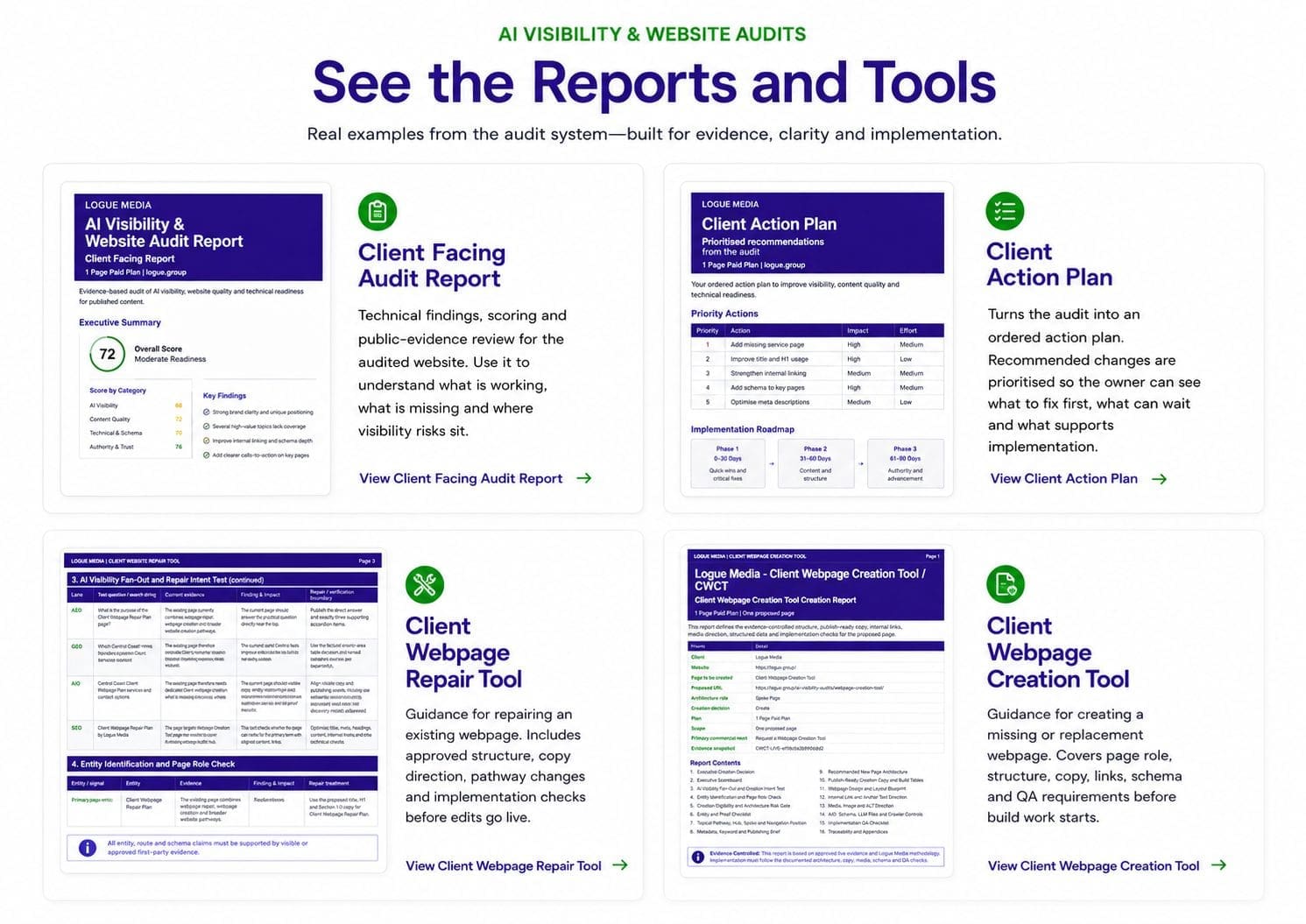
Webpage creation
Published product example
Webpage creation
Review the creation approach when a necessary page is missing. Agree its purpose and outputs, then confirm who will install and release it.
From findings to action
Turn the findings into work your team can deliver.
Agree the priorities, the person responsible and how each change will be reviewed.
Scope & pricing
Know what you are buying before work begins.
Use the calculator for page quantities and review options. Logue Media confirms the scope before invoicing.
| Service | Starting scope | Price |
|---|---|---|
| Website audit | 10-page CFAR | $1,450 + GST |
| Audit + action plan | 10-page CFAR and CAP | $2,450 + GST |
| Designed page repair | One-page CWRT+ | $1,950 + GST |
| Designed new page | One-page CWCT+ | $1,950 + GST |
Limited free pathways are subject to approval and have a different scope. Dedicated external-platform audit products remain in development. Explore the off-page public evidence review scope.
Questions before you book an AI visibility audit.
What is an AI visibility audit?
An AI visibility audit reviews the information available to explain your business to buyers, search engines and AI answer systems. Logue Media checks the selected website pages for clear services, useful answers, supporting evidence, structure and enquiry paths, then records the findings and priorities.
Does the audit cover SEO and local search?
Yes. The website review includes SEO structure and local information on the selected pages, such as genuine locations, service coverage and business details. It does not make a remote business local to every town. Public website findings are separate from a private Google Business Profile or Search Console review.
Will the audit show where we rank in ChatGPT or Google AI Overviews?
Website readiness and measured search visibility are different. A public website audit cannot establish every AI mention, citation or search position. Supplied search observations need their query, date and context recorded. Neither the audit nor implementation guarantees rankings or AI recommendations.
How much does an AI visibility audit cost?
Pricing depends on the report, selected page quantity and review options. Use the calculator for the current estimate. Logue Media confirms the scope and invoice before work begins; custom requirements are quoted separately.
Is a free audit available?
Limited free pathways are subject to Logue Media approval and are not equivalent to the paid scope. Check the current package terms or ask which option applies. The designed plus versions are paid services.
Do you need access to our accounts?
The public website review starts with your URL and agreed page scope. It does not require access to private analytics, advertising or business-profile dashboards. If private data is needed for another agreed task, access and permissions must be scoped separately.
Does the report include changes to our website?
An audit diagnoses issues; an action plan prioritises work. Repair and creation services are separate. CWRT+ and CWCT+ add visual design, review and implementation deliverables for the agreed website environment. Installation and release responsibilities must be confirmed in the scope.
Can our existing website developer use the findings?
Yes. You can use the report with your own team or developer, or discuss implementation with Logue Media. Confirm who will make changes, approve them and check the finished work.
How long does an audit take?
The delivery schedule is confirmed after the page scope and required outputs are agreed. Larger sites, custom requirements and review arrangements can change the schedule. Include any launch date or deadline in your request.
Can you work with a business outside the Central Coast?
Yes. Logue Media is based in Umina Beach and delivers suitable audits and advisory remotely across Australia. Central Coast businesses can also arrange an in-person discussion. A website audit does not require a visit to your premises.
Are external-platform audits available to buy?
The published hub identifies the dedicated public and private external-platform audit products as in development, not released for purchase. The off-page evidence page explains that area of review. Confirm availability with Logue Media before including it in a scope.
Choose your next step
Ready to define your audit scope?
Select the report, page scope and review options. If you are unsure which option fits, contact Logue Media before submitting. Suitable audits are delivered remotely across Australia.