
LOGUE MEDIA / CONTENT MARKETING
Content Marketing for Central Coast Businesses
Turn what you know into content buyers can use.
Explain your services, answer the questions customers ask and show the work behind your claims. Logue Media brings video, photography and written content together around a clear business purpose.
Video transcript — select a time to play
0:00content marketing is a powerful tool for businesses to connect with their audience and drive results it encompasses various elements such as
0:08video photography webpage copywritten text blogs infographics case studies client testimonials and white papers and
0:18emails by utilizing these different forms of content businesses can effectively engage their target market build brand awareness and establish
0:27themselves as industry leaders video content allows businesses to tell their story visually capturing the attention
0:34of viewers and conveying messages in a compelling Way Photography helps to create visually appealing content that can be used across various platforms
0:43from social media to websites webpage copywritten text is essential for optimizing websites and improving search
0:50engine rankings ensuring that businesses are easily discoverable by their target audience blogs provide a platform for
0:57businesses to share valuable insights industry Trends and thought leadership positioning themselves as experts in
1:04their field infographics are a visually appealing way to present complex information in a simple and digestible
1:11format making it easier for audiences to understand and retain key messages case studies and client testimonials showcase
1:20real life examples of how businesses have successfully solved problems and delivered results for their customers building trust and credibility white
1:29papers and emails are valuable resources that provide in-depth information and insights allowing businesses to educate
1:36Their audience and establish themselves as trusted sources of knowledge in today's digital age content marketing is
1:43more important than ever it allows businesses to cut through the noise connect with their audience on a deeper level and ultimately Drive business
1:52growth so if you want to stand out from the competition and make a lasting impression content marketing is the way to go oh
DIRECT ANSWER
What is content marketing?
Content marketing is the planned creation and use of helpful information to explain a business, answer customer questions and support buying decisions. It can include webpages, articles, photographs, videos, case studies and white papers. Logue Media starts with your knowledge and real business material, then shapes the content for the people you want to reach.
What does content marketing include?
Webpage copy, blog articles, case studies, white papers, photography and video can all form part of content marketing. Choose the formats that help your customers understand the business and make a decision.
How does content support search and AI answers?
Clear headings, direct answers and verifiable evidence make information easier to understand and retrieve. Content also needs suitable technical foundations and distribution; no format guarantees search rankings or inclusion in an AI answer.
Where should we start?
Start with the questions your customers ask and the information you already hold. Agree the audience, purpose, evidence and approval process before choosing the assets to produce.
BEFORE YOU CREATE MORE
A busy content calendar can still leave buyers confused.
You can publish every week and still fail to explain what you do, who it suits or why a customer should trust you. Disconnected posts, generic AI copy and unsupported claims leave those questions unanswered.
Start by identifying the decision your customer is trying to make. Gather the facts, examples and expert explanations that help them make it. Then choose the right format and publishing channel.
The aim is a useful body of content that works together: clear services, informed answers and evidence buyers can inspect.
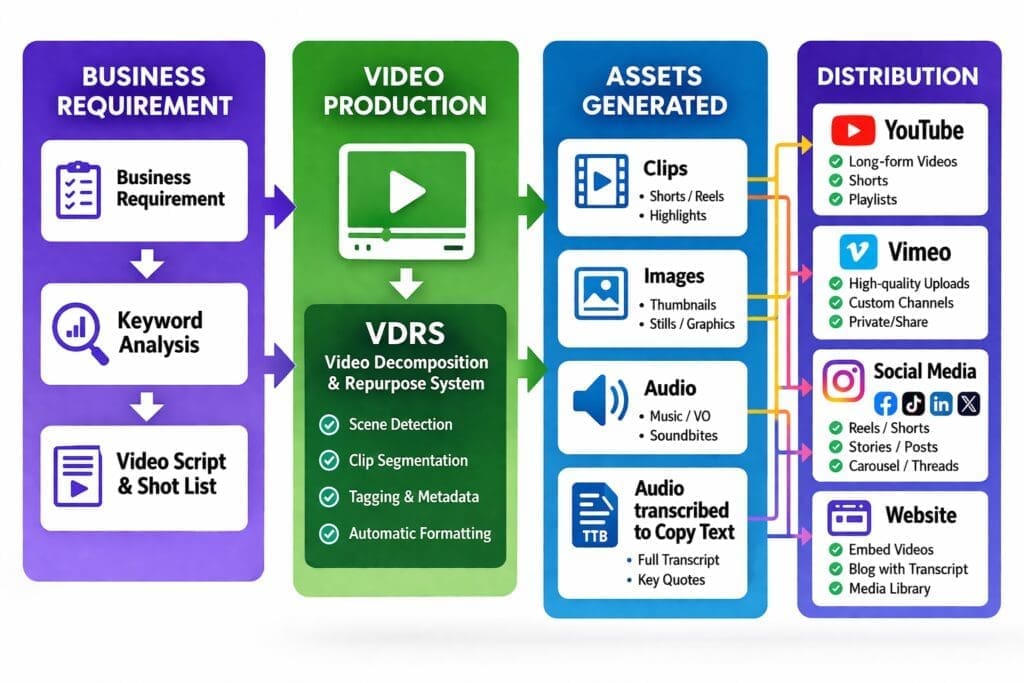
One source. Several useful assets.
Decompose.
Decomposition identifies and extracts the useful assets within a source recording. These can include video segments, transcripts, audio and still images—the raw material for your content marketing.
Repurpose.
Repurposing adapts the selected assets into useful content for your audience and publishing channels. Each output needs its own context, factual review and approval.
Choose content around the job it needs to do.
Explore the five Content Marketing services. The right mix depends on your audience, the information they need and the evidence you have.

Explain the service before you ask for the enquiry.
Webpage copy needs to answer the questions a visitor asks before contacting you: what you do, who it suits, how the work is delivered and what happens next. Start with the actual service and its boundaries, then organise the explanation around the buying decision.
What we need from you
- Existing webpages, service details and common customer questions.
- Examples, qualifications and factual claims your team can verify.
- A nominated reviewer who can confirm scope and wording.
What the brief can include
The agreed work may include page structure, headings, body copy, calls to action and contextual internal links. Titles, descriptions, image requirements and publishing can be included when they form part of the brief.
Before you approve
Review the draft for accuracy, clarity and a useful next step. Copy approval and website implementation are separate responsibilities unless both are included in the scope.

Answer a question worth answering.
Useful blog content tackles a specific question in enough depth to help the reader. It can explain a process, compare practical options or resolve a misunderstanding. Choose topics from customer conversations and gaps in your existing resources, with expert input supporting the answer.
What we need from you
- The question, intended reader and reason the article is needed.
- Subject-matter input, relevant experience and suitable sources.
- Existing articles and service pages that the new piece should connect with.
What the brief can include
Agree the topic, research boundaries, structure and review process. Deliverables can include the approved article, an introduction, contextual links and selected supporting visuals. Distribution versions are scoped separately.
Before you approve
Check facts, attribution and whether the article adds something useful to the existing library. Update or consolidate an older article when that better serves the reader than publishing another version of the same answer.

Show how the work was delivered.
A case study helps a prospective customer assess a real example of your work. Explain the original situation, the problem, the decisions made and the outcome the evidence supports. The value is in the detail that lets another buyer understand the approach.
What we need from you
- Project records, the original brief and an account of the work delivered.
- Approved client participation, images and any quotations.
- Evidence supporting the outcomes you want to describe.
What the brief can include
The agreed output may be a webpage, written case study, interview-led video or a combination. Structure it around the challenge, approach and supported outcome, with enough project context to make the example meaningful.
Before you approve
Confirm permissions and let the relevant people review factual statements. Include numbers and quotations only when verified and approved. Where results were not measured, describe what was delivered without inventing a performance claim.

Give a complex decision the depth it needs.
A white paper suits a reader who needs a researched explanation of a problem, options or an approach before deciding what to do. Set a clear question and audience. Depth comes from evidence, reasoning and expert review, rather than simply making the document longer.
What we need from you
- The decision or problem the document will help the reader understand.
- Expert access, existing research and appropriate source material.
- The research boundaries, intended use and approving reviewer.
What the brief can include
Agree the outline, research tasks, source handling, writing, design and delivery format. The output can include an executive summary, structured analysis, practical implications and references, with a downloadable version where required.
Before you approve
Review the argument, source quality and limitations before approval. Any landing page, lead form, email sequence or promotion needs its own agreed scope; creating a document does not automatically include its distribution.

Make your business visible with relevant images.
A useful photography library shows the people, products, workplace and delivery that customers need to understand. Plan the images around their destinations, including page banners, service sections, profiles and product details, rather than treating the shoot as an isolated collection of photographs.
What we need from you
- A shot list linked to the webpages and marketing uses you have planned.
- Location access, contributor permissions and prepared products or spaces.
- Required orientations, crops and delivery sizes.
What the brief can include
Agree the shoot, selection, editing and final file delivery. Capture a practical mix of wide context, details and people where relevant. Existing or licensed images may also be used when the rights and intended use are clear.
Before you approve
Review selections for relevance, accuracy and permissions. Confirm what is included in retouching, additional crops and future use. Licensed or illustrative images must not be presented as evidence of your own completed work.
Show the people and work behind your business.
Plan photographs and recordings for the places your content will appear.
Capture the knowledge once. Give each asset a purpose.
VDRS — the Video Decomposition & Repurpose System — connects a source recording with the content you actually need. Agree the audience and intended use before extracting clips, drafting copy or selecting images.
Reuse with a clear brief.
Source quality, permissions and evidence determine what can be reused. Each asset still needs editing and approval for its intended audience.
Explore our business solutions, or connect the assets with Search Marketing. New footage can be scoped through Video Production.
A clear path from brief to approved content.
Select a numbered card to see that stage.
Agree what the content needs to do.
Start with the customer question and the decision the content should support. Identify who will read or watch it, where it will appear and what a useful next step looks like. This keeps the work focused before recording, research or writing begins.
At this stage
- Choose the audience, priority questions and intended channels.
- Define the formats, quantity and boundaries of the work.
- Agree the inputs, reviewer, deadlines and review rounds.
Ready for the next step
The result is an agreed brief with clear deliverables and responsibilities. If the source material is incomplete, decide whether new research or production is needed before confirming the scope.
Collect the material that supports the story.
Gather the knowledge and evidence that give the content substance. Existing documents, project records and conversations with knowledgeable people can be as useful as a new recording. Review the material before deciding which parts can be reused.
At this stage
- Collect approved documents, footage, photographs and expert input.
- Check contributor permissions, licences and factual sources.
- Identify missing answers, unclear claims and outdated information.
Ready for the next step
The result is a reviewed source set, with gaps and permissions recorded. Decomposition can then identify useful video segments, transcripts, audio and still images from suitable recordings. A source asset still needs context and approval before publication.
Shape the selected assets for their destination.
Turn the agreed material into content that makes sense in its own format. A video clip needs enough context to stand alone; a webpage needs a clear structure and next step; an article needs a useful answer supported by evidence.
At this stage
- Extract the relevant source assets through decomposition.
- Write, edit or design each selected output for its audience.
- Add appropriate headings, visuals, links and calls to action.
Ready for the next step
The result is a set of review-ready drafts. Repurposing adapts the source assets rather than simply copying the same material into every channel. Confirm any extra versions, specialist production or publishing work against the agreed brief.
Review, verify and deliver.
Check the content against the brief before it is released. The nominated reviewer confirms that the business information is accurate and the wording reflects what you actually deliver. Contributors approve quotations and participation where required.
At this stage
- Verify claims, names, figures, permissions and source attribution.
- Complete the agreed review rounds and record final approval.
- Confirm final formats, delivery location and publishing responsibilities.
Ready for the next step
The result is an approved set of assets and a clear handover. Agree who uploads, distributes and maintains the content, including how future corrections will be handled. Any ongoing measurement or updating needs an agreed owner and scope.
Central Coast based. Remote content work across Australia.
Choose the delivery model that suits the content you need. We confirm access, contributors, travel and review arrangements in the brief.


Know what you are buying before content production starts.
The volume of content is only part of the quote. Research depth, source quality, expert availability, review rounds and publishing responsibilities affect the work involved.
| Scope area | What to agree |
|---|---|
| Purpose & formats | Which customer questions will be answered, and which webpages, articles, photographs or documents are included? |
| Inputs & evidence | Who supplies expert input, records, existing footage, permissions and claim verification? |
| Production & revisions | How much research, recording, design and editing is required? Which review rounds and deadlines apply? |
| Publishing & maintenance | Who uploads, distributes, measures and updates the content after approval? |
| Rights & extra costs | Which licences, contributor permissions, travel, specialist research and additional versions are separately scoped? |
Choose an agreed project or a recurring plan.
A defined content project can address a specific need. A recurring plan provides an agreed level of ongoing content work. See the current Content Marketing Plans & Pricing, or discuss a tailored scope.
Content connected to an existing business resource.
See how content supports existing business resources in these published client projects.
Creativ Digital
Video explanations connected to an evergreen blog library.

Bum Bum Store
Webpage copy, product information, images and video within an ecommerce project.
Questions to settle before you commission content.
Agree the inputs, review process and intended use so the content can do its job.
Do we need to start with video?
No. The starting point is your audience and the information they need. An interview or recording can capture useful expert input, but existing documents, project records and direct subject-matter input may also support the work.
Can you improve our existing content?
Yes, where the material remains useful and you have permission to use it. We check relevance, accuracy, gaps and the intended purpose before deciding what to rewrite, update or retire.
How is content marketing different from social media marketing?
Content marketing creates and organises useful assets such as webpages, articles and case studies. Social media marketing includes distribution and engagement on social platforms. They can work together, but publication and channel management need an agreed scope.
What do you need from us?
A clear brief, access to knowledgeable people, existing assets and evidence for factual claims. You also nominate the person who can approve content and confirm client or contributor permissions.
Is AI used to create the content?
AI can assist suitable research, organisation or drafting tasks. It does not replace source evidence, subject-matter review or final approval. Quotes, project outcomes and transcripts must come from actual authorised material.
How often should we publish?
Choose a frequency you can sustain with useful material and an available review process. Start with important service and buyer questions, then build a schedule around the audience and agreed capacity.
Will the content guarantee rankings or enquiries?
No. Content can improve how clearly your business communicates and supports buying decisions. Rankings and enquiries depend on other factors, including competition, demand, distribution and your wider website and marketing.
How is the cost determined?
The quote reflects the agreed assets, research, source material, production, review rounds and publishing work. Current recurring options are listed on the Content Marketing Plans page; specialised or additional work is scoped separately.
Start with your content brief.
Share the content you already have, the questions buyers ask and the assets you need. We will review the brief and agree a practical scope before production starts.
For a direct conversation, call 0411 199 997.
Connect your content to the next useful step.
Content belongs within a wider communication plan. Explore the services and pricing that support your next decision.
 Video ProductionHover or tap to explore