
LIGHT · SUPPORT · MOVEMENT
Lighting, Support & Camera Movement
Lighting should reveal the subject clearly. Camera movement should add meaning—not distract from it.
How we choose it ↓Our equipment register ↓THE BUSINESS QUESTION
Why does a business need lighting, support & camera movement?
Businesses need controlled lighting and deliberate camera movement to show products, people and locations consistently. Logue Media uses lighting, stands, sliders, gimbals and other supports only when they improve clarity, depth, safety or the viewer's understanding.

THE ISSUE TO SOLVE
Poor lighting and unnecessary motion weaken credibility
A person in shadow, a reflective product or a shaky walkthrough makes the audience work harder. Elaborate moving shots can distract from the evidence viewers came to see.
The production decision: assess daylight, reflective surfaces, power, safe stand placement, movement paths and continuity before assigning equipment. Clear evidence matters more than movement for its own sake.
FROM BUSINESS INTENT TO TECHNICAL CHOICE
Shape the image and move with purpose
Four choices determine a practical approach to lighting, movement and safety. Read each one in order.
Card 1 of 4 — read this card, then continue.
01 / 04
Subject
Identify the faces, objects, finishes or processes that must be clearly understood on screen.
02 / 04
Lighting plan
Evaluate daylight change, reflections, colour balance, safe power and access before choosing fixtures.
03 / 04
Movement plan
Choose locked-off, sliding, stabilised or elevated views only when the perspective helps the audience.
04 / 04
Safety & continuity
Secure stands and cables, check rig loads, rehearse the planned movement and maintain continuity.
THREE DIFFERENT BRIEFS
What changes when the business changes?
Choose an assignment. The image and the explanation change together, because what a customer needs to understand determines the practical production plan.

A professional on camera
Business need: A medical or professional-services expert needs a consistent presentation.
Selection logic: Balanced key and fill lighting can improve visibility and minimise distracting variations between shots.
Illustrative configuration, not a claim about a named client project.

A product close-up
Business need: A manufacturer wants customers to examine shape, texture or a working detail.
Selection logic: Modifiers, reflections and small controlled moves can reveal the feature without inventing product performance.
Illustrative configuration, not a claim about a named client project.

A moving site tour
Business need: A venue manager needs visitors to understand flow and layout.
Selection logic: Selected stabilised or sliding shots can show spatial relationships while static detail shots preserve clarity.
Illustrative configuration, not a claim about a named client project.
CAPABILITY IN CONTEXT
Equipment is the means, not the outcome.
We plan the people, site, method, technology and review checkpoints together. A useful result needs more than the right brand or model.
WHAT WE MAY SELECT
Lighting, support and movement equipment we use or recommend
Logue Media uses or recommends suitable lighting, grip and movement equipment according to the brief. We do not sell these products, and no project requires every item. Availability, compatibility, operator requirements and the client brief must be confirmed.
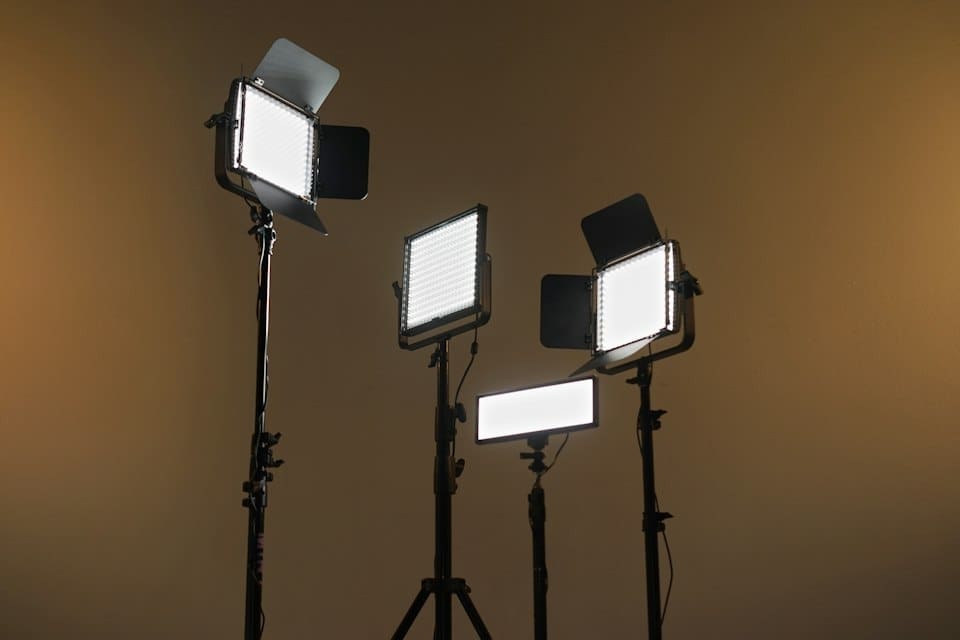
Neewer 660 LED panels
Flexible supplemental light for appropriate interviews and small controlled setups.
Illustrative stock photo — not necessarily the exact model shown
Godox SL-60W and 1 Godox SL-200
Continuous lighting options whose use depends on room, modifier, power and desired effect.
Illustrative stock photo — not necessarily the exact model shown
70, 90 and 120 cm hexadecagon softboxes
Light modifiers for shaping the apparent softness and direction of suitable light sources.
Illustrative stock photo — not necessarily the exact model shown
Neewer heavy-duty stands and Neewer steel C-stands
Support equipment for planned fixtures and safe positioning.
Illustrative stock photo — not necessarily the exact model shown
Neewer tripod dollies
Controlled camera moves when floor, tripod, lensing and subject make them useful.
Illustrative stock photo — not necessarily the exact model shown
Zhiyun Crane 4 Pro
Stabilisation options for carefully planned moving shots.
Illustrative stock photo — not necessarily the exact model shown
Jib/crane
More specialised movement and support choices that require specific planning and safe operation.
Illustrative stock photo — not necessarily the exact model shownWHERE VALUE IS LOST
What we check before the assignment
- Choosing lighting solely for brightness and ignoring reflection or colour
- Moving the camera because the equipment can move
- Failing to secure support equipment around people or walkways
- Using multiple lighting angles that cannot be matched during editing
QUESTIONS BEFORE COMMITTING
Questions business owners commonly need answered
Do all interviews need studio lighting?
No. Available light may be suitable. Additional lighting is selected where consistency, control or subject visibility warrant it.
What is the difference between a gimbal and a slider?
A gimbal can support selected stabilised movement through a space. A slider supports a shorter controlled camera move. Neither is inherently right for every story.
Can an overhead or jib shot always be provided?
No. Ceiling height, site access, permissions, support loads and safety determine whether elevated or moving rigs are feasible.
Why are stands and modifiers part of the story?
They help direct light and position equipment safely, which affects the consistency and clarity of the final recorded evidence.
EXPLORE CONNECTED CAPABILITIES
Related capture and production technology
Lighting and camera movement depend on the camera, sound capture and intended story; related guides explain how these choices work together.

AI, Software & Integrated Systems
Understand when AI, VDRS, AISRO and BAIMI methods support business knowledge, evidence and delivery workflows—and why people remain accountable.
View AI, Software & Integrated Systems →
Cameras & Video Capture
How Logue Media selects cameras and perspectives around audience intent, production conditions, and credible business evidence.
View Cameras & Video Capture →
Editing, Colour Grading & Post-Production
How Logue Media uses DaVinci Resolve Studio, dedicated editing controls and review workflows to turn recorded footage into clear, approved business assets.
View Editing, Colour Grading & Post-Production →
Livestream & Broadcast Technology
The business case for reliable live production systems: switching, audio, connectivity, rehearsals and practical contingencies.
View Livestream & Broadcast Technology →
Microphones & Audio Recording
Business-first microphone selection, speech clarity, acoustic planning and professional audio capture for interviews, demonstrations and presentations.
View Microphones & Audio Recording →
Podcast & Sound Engineering
Explore the recording, mixing and monitoring systems Logue Media uses to make business podcasts, interviews and panel conversations easier to follow.
View Podcast & Sound Engineering →Need help with lighting, camera support or movement?
Explain the setting, subject and desired visual result so the lighting and movement plan can be scoped.
We scope a production or integration solution; we do not sell individual equipment.
FROM REQUIREMENT TO DELIVERY
Explain the business challenge first
You don't need to know the right camera, microphone, software or production workflow. Tell us what the customer needs to see, hear or understand, where the work happens and what decision the result should support.
How we work together →Video production services →Explore all technology →